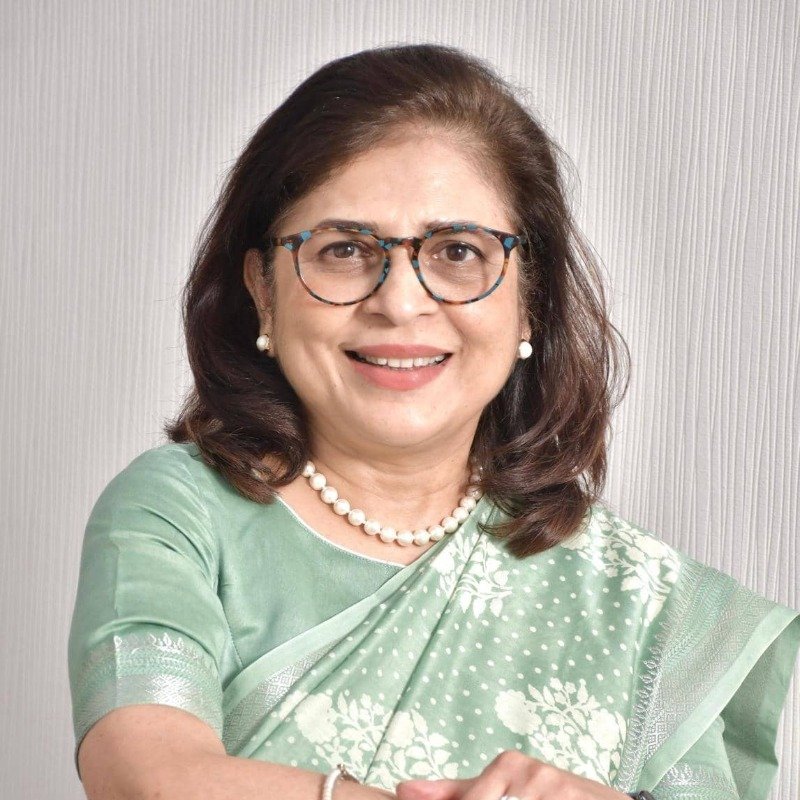
Jayshree Ullal’s first job change was a layoff. “Why did you leave Fairchild to AMD?” a podcast host asked her decades later. “I got laid off,” she said. “It’s a very humiliating experience, which is why I would never do it to my own employees.” She has now run the same company for eighteen years without laying off enough people for anyone to write about it, and without a quarter of losing money.
In September 2008, two Cisco veterans, Andy Bechtolsheim and David Cheriton, asked her to run a startup with no revenue and fewer than fifty employees. She had spent fifteen years at Cisco by then, rising to a role overseeing a business worth billions. She took the startup job anyway. It was called Arastra. It is now Arista Networks, and it is worth roughly a quarter of a trillion dollars.
Fifteen years building Cisco’s biggest business, then walking away from it
Ullal was born in London, raised in New Delhi, and trained as an electrical engineer at San Francisco State before an engineering-management master’s at Santa Clara. Her early career reads like a tour of the companies that built Silicon Valley’s networking industry: Fairchild Semiconductor, then AMD, then Ungermann-Bass, which she joined, in her own words, because she wanted “a little more instant gratification” than a large company offered. In 1992 she joined Crescendo Communications, a fifty-person startup building early Ethernet switching technology. Cisco bought it the following year for roughly $97 million in stock, its first acquisition ever and its entry into switching.
She stayed at Cisco for fifteen years, building the Catalyst switching line from its 1993 start into a five-billion-dollar business, and rising by 2005 to Senior Vice President of the Data Center, Switching and Security Technology Group, a unit generating billions in direct and indirect revenue. She has said she left in 2008 looking for “a fresh start, an entrepreneurial opportunity.” Cisco was, at that point, the safest job in networking. She left it for a company with no customers.
The two customers Arista cannot stop depending on
Arista’s own most recent annual filing states that 48% of its revenue now comes from a category it calls “Cloud and AI Titans”, in practice a handful of the largest cloud computing companies in the world. Microsoft alone was 20% of total revenue in fiscal 2024, Meta another 15%. That concentration is the single risk analysts return to most often: if one of those companies decided to build more of its own networking hardware, or if their AI spending simply slowed, Arista would feel it faster and harder than a more diversified supplier would. On a February 2026 earnings call, asked directly whether more customers were approaching that scale, Ullal did not oversell the certainty of it, citing variables like “acceptance criteria and supply chain constraints” that could still affect whether they crossed the line. It is a risk she has been answering in public since at least 2014, when she wrote Arista’s own rebuttal to Facebook’s push into building its own switches in-house.
What eighteen years in one seat has actually produced
Arista’s revenue passed $9 billion for full-year 2025, up nearly 29%, and the company’s own mid-2026 guidance points toward roughly $12.6 billion for the year, growth of about 40%. Q2 2026 was its first-ever $3 billion quarter. Adjusted for two 4-for-1 stock splits since its 2014 IPO, the stock has returned somewhere in the range of seventy times an investor’s money. Ullal’s own stake, after routine sales under a pre-arranged trading plan, was worth about $3.3 billion in August 2026; Forbes puts her total net worth at $6.8 billion, the highest of any Indian-origin woman on its list of America’s richest self-made women.
She still describes the company’s edge in engineering terms rather than financial ones: “the model at Arista is engineering first, you have to be ten times better to beat the competition.” Whether that edge survives the next stage, in which the AI-driven demand from two enormous customers either keeps compounding or starts to plateau, is the question the stock price is currently betting will resolve in her favour.
The record
Sources
- Arm, Tech Unheard podcast, episode 11, her own account of her early career, 15 December 2025
- Cisco newsroom archive, the Crescendo acquisition terms, 24 September 1993
- Arista Networks investor relations, Q4 and full-year 2025 results, 12 February 2026
- SEC EDGAR, Arista’s FY2025 Form 10-K, customer concentration disclosure, filed February 2026
- Trefis, market capitalisation, 15 August 2026
- Forbes, real-time net worth and America’s Richest Self-Made Women ranking, checked 19 August 2026
- Santa Clara University School of Engineering, on her engineering-first management quote, 17 August 2015
- LinkedIn, role history, checked 19 August 2026
Questions people ask about Jayshree Ullal
Who is Jayshree Ullal?
Jayshree Ullal is the Chair, President and CEO of Arista Networks, a role she has held since September 2008. She previously spent 15 years at Cisco, rising to Senior Vice President of its Data Center, Switching and Security Technology Group.
When did Jayshree Ullal become CEO of Arista Networks?
She was named President and CEO of Arastra, later renamed Arista Networks, in September 2008, when the company had fewer than 50 employees and no revenue.
What did Jayshree Ullal do before Arista Networks?
She spent 15 years at Cisco Systems after it acquired her employer, Crescendo Communications, in September 1993 for roughly $97 million, Cisco’s first-ever acquisition. She helped build Cisco’s Catalyst switching business.
How big is Arista Networks now?
Arista’s revenue passed $9 billion for full-year 2025, up nearly 29%, and the company guided toward roughly $12.6 billion for 2026. Its market capitalisation was roughly $250-313 billion as of mid-August 2026.
What is Jayshree Ullal's educational background?
A BS in Electrical Engineering from San Francisco State University and an MS in Engineering Management from Santa Clara University.
What is the biggest risk to Arista Networks?
Customer concentration. Arista’s FY2025 filing shows 48% of revenue coming from a small number of large cloud computing customers, with Microsoft alone at 20% of total revenue in fiscal 2024 and Meta at 15%.
What is Jayshree Ullal's net worth?
Forbes estimated her net worth at $7.7 billion on 8 October 2026. Arista’s 2026 proxy statement shows she beneficially owned 29,300,817 Arista shares, 2.3% of the company, on 2 April 2026, and that her total compensation for 2025 was $2,872,145. Sources: Forbes, Arista proxy statement.