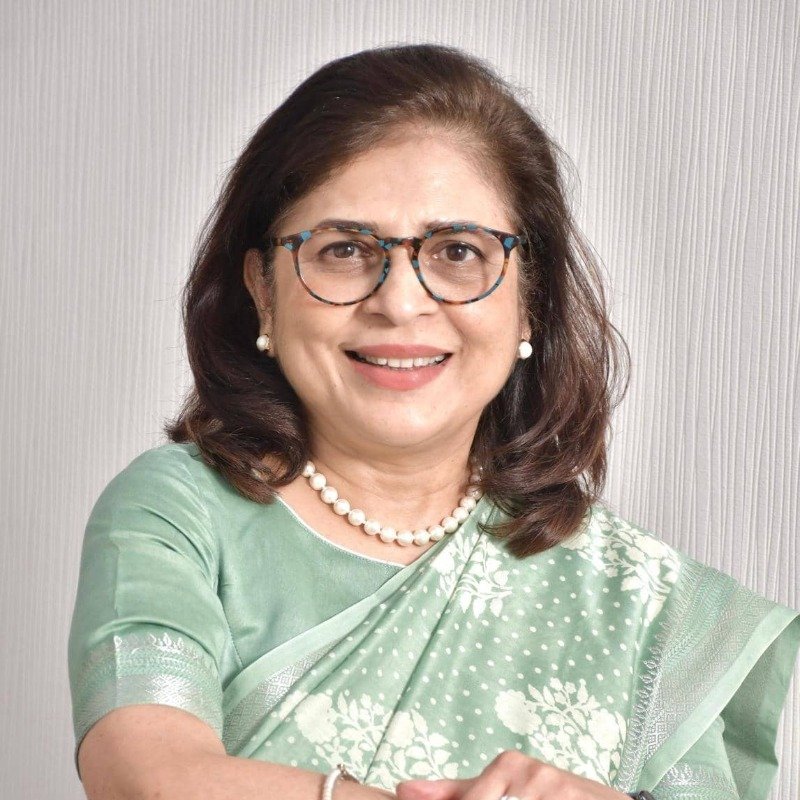
Vibha Padalkar keeps answering in four-year cohorts, in a business that is marked every ninety days. She has just been given five more years to be judged on it.
“Doubling every key metric in 4 years.” She has posted some version of that line at least three times since 2023: once when assets under management passed ₹2.5 trillion, once about a set of full-year results, once about the four-year cohorts themselves.
It is a strange sentence for the chief executive of a listed company to keep repeating. Life insurers are marked every ninety days on value of new business, margin and persistency, and the marking is done by analysts who have the model open while she is still speaking.
On 19 August 2026 the insurance regulator approved her reappointment as managing director and chief executive of HDFC Life for a further five years from 12 September. Her board had cleared it in April. The date is the same one her first term began on, in 2018. Serve this one out and she will have spent twenty-three years at one company and thirteen of them running it.
What she has been handed is time. Time is the only input her method has ever actually required.
She was the company’s accountant for a decade before she was its chief executive
She qualified with the Institute of Chartered Accountants of England and Wales in 1992 and is a member of the Indian institute too. The first seven years of her career were spent inside Colgate-Palmolive’s finance function, in Mumbai and New York, doing corporate reporting. Then six and a half years at WNS Global Services as executive vice president for finance. She arrived at HDFC Life in August 2008 as executive director and chief financial officer and stayed in that seat for a decade, including through the company’s listing on 17 November 2017. She took over as chief executive on 12 September 2018, succeeding Amitabh Chaudhry.
Most Indian insurance chief executives come up through distribution or actuarial. She came up through the ledger, and it shows in what she chooses to be measured on. Her public scorecard is almost entirely composed of ratios rather than launches: overall individual weighted received premium share up from 7.5% in FY2018 to 11.1% in FY2025, assets under management through ₹3 trillion in June 2024 and past ₹4 lakh crore in the June 2026 quarter, and the first merger and acquisition the Indian life insurance industry had ever done.
The four-year framing is a finance person’s instinct applied to a product that pays out over forty years. It is also, conveniently, a timeframe long enough to smooth a bad quarter. She has just been given five more of them.
The best part of her last quarter was everything the parent bank did not touch
Here is the case against her at full strength, and every number in it comes from HDFC Life’s own release.
In the quarter to 30 June 2026, individual annualised premium equivalent grew 7%. Management’s own stated expectation for industry growth this year is 15% to 17%. Overall market share on individual weighted received premium fell to 11.2% from 12.1% a year earlier. Thirteenth-month persistency, the share of customers who pay a second year, slipped to 84% from 86%. Expenses as a proportion of total premium rose to 22.6% from 21.9%. Operating return on embedded value fell to 14.7% from 16.3%. Solvency came down to 185% from 192%, helped back up by a ₹1,000 crore preferential capital issue to HDFC Bank.
The reason sits in one line of the distribution table. Bancassurance is 57% of individual annualised premium equivalent, and the largest counter inside it belongs to her own parent. That channel was flat. Everything she controls directly grew 17%, agency alone 21%, retail protection 42%.
So the quarter reads as a company doing well at the parts it owns and waiting on the part it does not.
Her own people said as much. Vineet Arora, the chief business officer, told analysts there had been “irrational competitive intensity in the counter, which led to our share dropping.” Nidhesh Jain of Investec put the question without decoration: “what gives you confidence that HDFC Bank channel will start to revive soon? And what is exactly happening there? Because last year also growth was soft for us. And this year, again, Q1 is quite weak for HDFC Bank channel?” Sanketh Godha of Avendus Spark told her the company’s account of demand for non-participating products had changed since the previous call, and that it was “bit confusing to make a clear conclusion”.
When Dipanjan Ghosh of Citi asked how much of HDFC Bank’s wallet she was actually winning, she declined. “It is higher. At the same time, you will appreciate that we are in an intense open architecture scenario. And so, some of that information is difficult for us to share given these are competitive dynamics. But it is noticeably higher.”
That is a chief executive telling the market that her single most important dependency is a number they may not have. She may well be right to withhold it. It remains the one figure that would settle whether the last eight years were operating skill or the best distribution shelf in Indian financial services.
She counted the women running large listed Indian companies herself
In August 2025, sharing a Mint feature on Indian women business leaders, she added a note that had nothing to do with insurance. “As of Aug 1, there are only 5 non-promoter led women MD & CEOs heading large cap listed companies in India. This number should be atleast a third! Clearly there’s work cut out for India Inc!”
The detail worth holding onto is that she did the count. Not a commissioned diversity report, not a conference statistic. A working chief executive worked out the size of her own category, published it, and named the number it ought to be. It is the same instinct as the four-year cohorts: if a thing matters, put a figure on it and let the figure make the argument.
She uses it defensively too. In May 2025, resharing an Emkay Global report on the industry, she made her position on bank distribution public: “By materially reducing last mile customer connectivity, we will struggle to realise our objective of ‘insurance for all by 2047!’… but throwing the baby out with the bath water is rarely the solution!” She is defending the channel that is simultaneously her greatest strength and her most-questioned dependency, and she is defending it on the grounds of reach rather than her own revenue.
What the next five years actually test
Her appointed actuary, Eshwari Murugan, was asked on the same call whether persistency returns to where it was. The answer was careful: “We expect it to be in 84%-85% range. It’s difficult to say that it will go up to 87%, 88% as we have seen.”
That is the shape of the term ahead. The easy compounding, off a small base, in a market where private insurers were taking share from the state incumbent, is behind her. What is left is a bigger company growing below its own stated industry expectation, with a fifth of every premium rupee going to expenses, and a bank counter that has to come back for the arithmetic to work.
She has spent eight years asking to be judged over four-year cohorts. She has now been given five years, and the first of them will decide whether the yardstick was insight or patience.
The record
Sources
- HDFC Life, press release, performance for the quarter ended 30 June 2026, 15 July 2026
- HDFC Life, Q1 FY27 investor presentation, on the distribution and product mix, 15 July 2026
- HDFC Life, Q1 FY27 earnings call transcript, for all quotations from Padalkar, Vineet Arora, Eshwari Murugan and the analysts, 15 July 2026
- HDFC Life, leadership, on her tenure, the 2017 listing, market share since FY2018 and the sector’s first M&A
- CNBC-TV18, HDFC Life gets IRDAI approval for reappointment of MD and CEO Vibha Padalkar, 19 August 2026
- The Economic Times, on the board approving the reappointment, 21 April 2026
- Rediff, HDFC Life sees strong Q1 margins, but growth lags peers, 26 July 2026
- LinkedIn, her post on women chief executives of large-cap listed Indian companies, August 2025
- LinkedIn, her post on bank distribution and insurance reach, May 2025
- LinkedIn, her post on doubling key metrics over four-year cohorts, April 2025
Questions people ask about Vibha Padalkar
Who is Vibha Padalkar?
Vibha Padalkar is the Managing Director and Chief Executive Officer of HDFC Life Insurance Company. She joined HDFC Life in August 2008 as executive director and chief financial officer, served in that role through the company’s listing in November 2017, and became chief executive on 12 September 2018. She is a member of the Institute of Chartered Accountants of England and Wales and of the Institute of Chartered Accountants of India.
Has Vibha Padalkar been reappointed as HDFC Life CEO?
Yes. HDFC Life’s board approved her reappointment on 21 April 2026, and the insurance regulator IRDAI approved it on 19 August 2026. The new five-year term runs from 12 September 2026, the same calendar date her first term began on in 2018.
What did Vibha Padalkar do before HDFC Life?
She spent roughly seven years at Colgate-Palmolive in corporate reporting, working between Mumbai and New York, from 1994 to 2001, then six and a half years at WNS Global Services as executive vice president for finance, from 2001 to 2008.
How has HDFC Life performed under Vibha Padalkar?
HDFC Life’s overall individual weighted received premium market share rose from 7.5% in FY2018 to 11.1% in FY2025, assets under management passed 3 trillion rupees in June 2024 and 4 lakh crore in the quarter to June 2026, and the company completed the first merger and acquisition in the Indian life insurance sector. In Q1 FY27 profit after tax was 611 crore rupees, up 12%, with a new business margin of 25.0%.
What is the main risk to HDFC Life's growth?
Bancassurance accounts for 57% of individual annualised premium equivalent, and the largest bank counter belongs to its parent HDFC Bank. That channel was flat in the quarter to June 2026 while every other channel grew 17%, and individual annualised premium equivalent grew only 7% against management’s own expectation of 15% to 17% industry growth.
How many women run large listed Indian companies?
In August 2025 Padalkar posted her own count: as of 1 August that year there were only five non-promoter women managing directors and chief executives heading large-cap listed companies in India. She added that the number should be at least a third.